
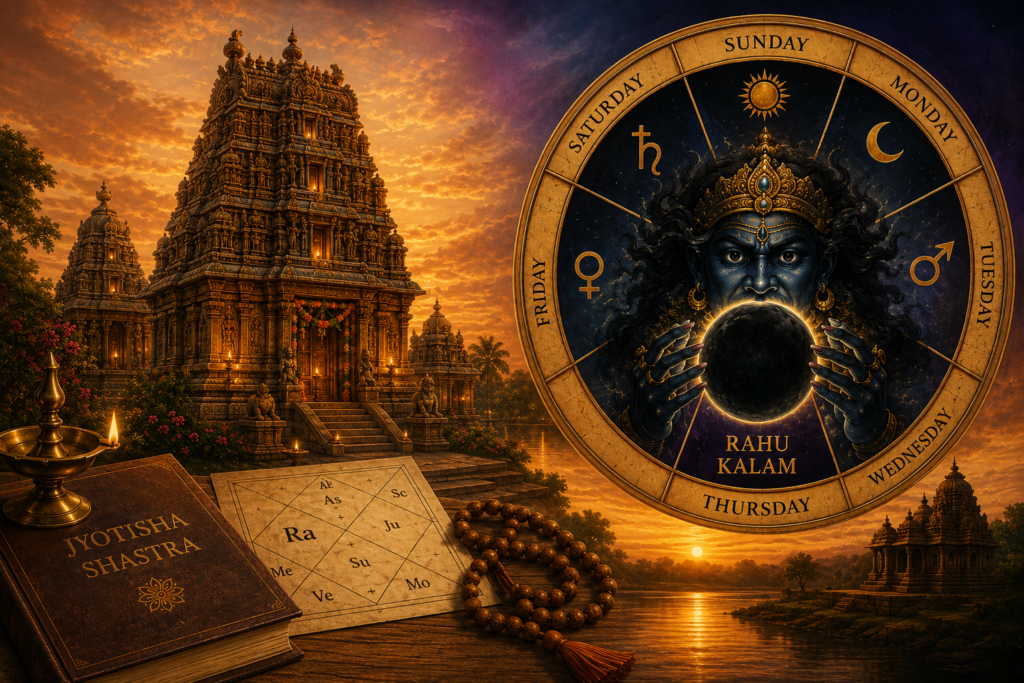
Is Rahu Kalam Really Inauspicious? What Vedic Astrology Actually Says
I still remember how often my elders would tell me to avoid starting anything important during Rahu Kalam. As a child, I took it at face value. As an astrologer, I now understand exactly why that advice exists, and just as importantly, where it gets misunderstood.
Rahu Kalam is one of the most talked about and least understood concepts in everyday astrology. Some people plan their entire day around it. Others dismiss it as superstition. The truth sits in between, and this is a question I am asked constantly, both in consultations and by viewers of my channel.
Rahu Kalam does not require you to pause your entire day. It specifically cautions against beginning something significant, such as a journey, a signature, or a major decision, during a roughly ninety minute window that occurs daily. Ongoing activities are unaffected.
What Is Rahu, and Why Does He Get His Own Time Window?
Rahu is a graha in Vedic astrology, though it does not have a physical form the way the Sun or Moon does. It is what we call a chaya graha, a shadow influence. Astronomically, it represents the point where the Moon's orbit crosses the Sun's ecliptic, known as the North Node. Ketu, the South Node, is its counterpart. This is why Rahu and Ketu are so closely tied to eclipses.
The daytime, from sunrise to sunset, is divided into eight equal segments ruled by different grahas, and Rahu Kalam is one of these eight segments. On a day with approximately 12 hours of daylight, it works out to about 90 minutes. It occurs every single day without exception.
The Puranic Story Behind Rahu and Ketu
There is a well known story from our puranas that explains why Rahu behaves the way he does. During the samudra manthan, the churning of the cosmic ocean, Sri Vishnu took the form of Mohini to distribute amrita, the nectar of immortality, among the devas while keeping it from the asuras. One asura, Swarbhanu, suspected foul play. He disguised himself as a deva and sat between Surya and Chandra to receive his share of the nectar.
Just as he drank it, Surya and Chandra recognised him and alerted Mohini. Vishnu immediately used the Sudarshana Chakra to sever his head. But since the nectar had already passed his throat, both halves remained alive. The head became Rahu and the headless body became Ketu. Because Surya and Chandra were responsible for exposing him, it is said that Rahu and Ketu cause solar and lunar eclipses as a form of retribution against them to this day.
Sage Veda Vyasa describes Rahu's power directly. The shloka pays tribute to Rahu, born from the womb of Simhika, possessing only half a body yet powerful enough to overshadow both the Sun and the Moon. What this really tells us is that Rahu has a genuine, recognised influence over Surya and Chandra, and this is the foundation of why Rahu Kalam matters at all.
Why Rahu Kalam Is Traditionally Linked to Judgment and Clarity
In astrology, the Sun represents the atman or our soul, and the Moon represents the mind. Since Rahu has no body of his own, he is associated with unresolved craving, illusion, and confusion. Traditionally, Rahu is associated with illusion, confusion, and a tendency to cloud judgment. This is one reason Rahu Kalam is treated with caution when beginning something important, which is exactly why our elders cautioned against beginning anything important during this window.
What to Actually Avoid During Rahu Kalam
This is the part most people get wrong. I regularly meet people who pause their entire day, avoid phone calls, meals, or even simple errands during this window. That level of caution is not necessary, and it is not what the shastras actually prescribe. The concern is not the ninety minutes themselves. It is the clarity of the decision made at the very start of something significant.
You are about to sign a contract, begin a journey, make an investment, schedule a surgery, or start an important conversation such as a proposal or a resignation. This is exactly when I recommend checking Rahu Kalam and choosing a different window if possible. The clouded judgment Rahu brings has the most impact right at the point of commitment.
You started your journey, meeting, or task before Rahu Kalam began. There is no need to stop or worry. Your daily routine, ongoing work, and anything already set in motion carries no meaningful dependence on Rahu Kalam.
How to Find Your Rahu Kalam Timing
The weekday sequence is fixed, but the actual clock time depends on the local sunrise and the length of daylight. I always recommend checking a reliable panchangam for your specific location rather than relying on a fixed table. The order across the week is not intuitive either, which is why there is a well known mnemonic to remember it: mother saw father wear the turban, where each word's first letter corresponds to a day starting from Monday.
The Overlooked Spiritual Side of Rahu
What surprises most people is that Rahu is not purely negative. During eclipses, which are Rahu's most direct expression, many spiritual traditions consider meditation especially powerful. Offering prayers during Rahu Kalam itself is considered auspicious for removing obstacles, and temples such as the Durga Devi temple, the Rahu temple, and Kalabhairava temple are especially favoured for this. Rahu can work against material clarity while still supporting spiritual depth. It depends entirely on what you are trying to align.
My Honest Take
Rahu Kalam is not something to fear, and it is not something to ignore either. I see it as a simple, practical checkpoint rooted in a genuine astronomical and astrological principle, not blind superstition. If you are about to begin something that truly matters, whether that is a business decision, a big conversation, or a financial commitment, a ninety minute pause to choose a clearer moment is a small price for better judgment. Everything else in your day can continue exactly as planned.
Frequently Asked Questions About Rahu Kalam
Does Rahu Kalam occur every day?
Yes, it occurs every single day without exception, always within daylight hours.
Is it at the same time every day?
No. The order of days follows a fixed sequence, but the actual clock time depends on that day's sunrise.
Are the timings the same every week, say always 1:30 pm to 3:00 pm on Thursdays?
No. Rahu Kalam is calculated from sunrise, so the exact time shifts through the year as sunrise shifts. A generic table assumes a fixed 6:00 am sunrise, which is rarely accurate for your location and date.
Are Rahu Kalam timings the same everywhere in the world?
No. Since sunrise varies by location, Rahu Kalam varies too. For instance, on the same calendar date, Rahu Kalam in Bengaluru, where sunrise is earlier, will fall at a noticeably different clock time than Rahu Kalam in a city like New York or Los Angeles, where sunrise is later. This is exactly why a single generic timing table cannot work for everyone.
Does Rahu Kalam only happen during the day?
Yes, it is calculated within daylight hours only.
Should all activity stop during Rahu Kalam?
No. This is the most common misunderstanding. Ongoing activities are unaffected. It is specifically the start of something important, such as a journey, a signature, or a major decision, that is best avoided during this window.