
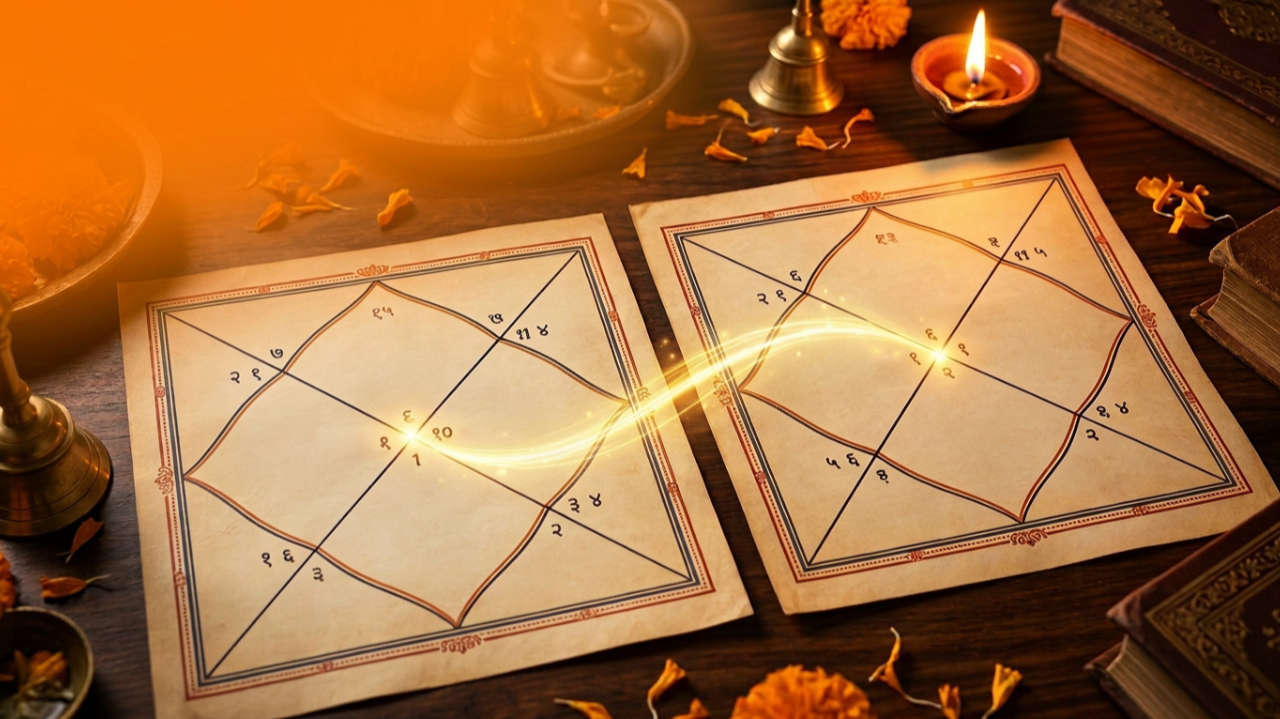
Kundli Matching for Marriage: Why a Free Online Calculator Is Not Enough
You enter the birth details. The tool generates a score.
Maybe it says 28 out of 36, or 22 out of 36.
And naturally, the next question arises: Is this good enough to get married?
This is a situation I encounter very often. A client reaches out — not because the score was low, but because something still feels uncertain. Sometimes the score is quite high, yet the couple wants to understand what it truly means for them, specifically.
Marriage is one of the most important decisions in life. It is natural to seek clarity before moving forward. In India, Kundli matching for marriage is a traditional step many families follow before confirming a wedding.
A compatibility score from an online tool may feel reassuring — but astrology was never meant to reduce something as layered and sacred as marriage to a single number. Free online Kundli matching calculators are not wrong — they are simply incomplete. And when it comes to a decision this significant, incomplete information can lead to misplaced confidence — or unnecessary anxiety.
In my practice, I often see families rely only on the score from an online tool. But once we examine the full horoscope, the picture becomes much clearer.
Free online Kundli matching calculators usually calculate the Ashtakuta score correctly. However, the score alone does not reveal the full compatibility between two horoscopes.
A proper analysis also examines individual charts, planetary placements, the Navamsa chart, and planetary periods (Dashas).
What a Free Kundli Matching Calculator Actually Measures
Most online tools use the Ashtakuta system — an eight-factor compatibility framework from classical Vedic astrology, covering everything from temperament and emotional compatibility to physical harmony, health, and family welfare. Together, these factors give a total score out of 36 points, and traditionally a score above 18 is considered acceptable.
Here is something many people do not realise: 21 of those 36 points come from Nakshatra matching — not Rashi matching. Yet most calculators simply display the final score without explaining the breakdown, or what it actually means for a specific relationship.
In Vedic astrology, Kundli matching — also known as horoscope compatibility analysis — is traditionally performed before marriage to understand how two individuals may relate to each other emotionally, mentally, and practically.
To understand why, think of it this way: your Janma Rashi (Moon sign) is like the cover of a book, and your Janma Nakshatra — the precise lunar asterism at the time of your birth — is the story inside. Judging compatibility from the Rashi alone is like deciding whether to read a book purely by its cover.
Nakshatra compatibility explores emotional tendencies, mental patterns, and how two individuals naturally relate to each other at a deeper level. A number on a screen cannot capture all of that.
Five Things a Free Calculator Cannot Tell You
Even a perfectly calculated Ashtakuta score is only one layer of the analysis. A professional Kundli matching consultation goes far beyond the score displayed on a calculator. It examines several deeper dimensions that no automated tool can evaluate.
1. The Individual Charts
Compatibility cannot be understood in isolation. Before comparing two charts, each horoscope must be read independently — examining the strength of the 7th house (the house of marriage) and checking for factors such as Vivaha Dosha and Santhana Dosha. A strong composite score cannot compensate for a deeply afflicted marriage house in one partner’s chart.
2. Venus and Jupiter — The Relationship Planets
In Vedic astrology, Venus (Shukra) represents love, affection, and emotional expression within a marriage. Jupiter (Guru) represents wisdom, trust, and the blessings that sustain a union. A well-placed Venus brings warmth and reciprocity. A strong Jupiter can uplift a marriage even when other placements present challenges. These planetary influences cannot be assessed through a compatibility score alone.
3. The Navamsa Chart (D9)
The Navamsa chart is considered one of the most important divisional charts for understanding marriage in Vedic astrology. It reveals the deeper quality of the relationship that unfolds over time — how the partnership evolves once the initial stage of marriage settles. The placement of Venus in the Navamsa, in particular, provides insights that the main chart alone cannot reveal. Free calculators do not examine this level of detail.
4. Dasha and Timing
Compatibility is not static — it is experienced differently depending on the planetary periods (Dashas) both partners are running. A couple may be fundamentally well-matched but face real turbulence if their current Dashas activate challenging placements. Conversely, a modest compatibility score can still lead to a harmonious marriage when both individuals are in supportive planetary periods. Timing is deeply personal — and it matters enormously.
5. Character and Behavioural Tendencies
A horoscope can reveal how a person relates to the institution of marriage — whether they seek fulfilment at home or tend to look for happiness outside it, how they approach commitment, and what they need emotionally from a partner. These are nuanced, sensitive areas of interpretation that require a trained astrologer’s judgment within the full context of a chart. An algorithm simply cannot interpret these layers.
A Score Is a Starting Point, Not a Verdict
Over the years, I have seen marriages thrive with a compatibility score of 19, and I have seen couples with scores above 30 face significant difficulties.
The number is not meaningless — but it was never designed to be the final word.
The classical sages who developed these systems were clear: Kuta matching is one part of a much larger picture. A low score with awareness and appropriate remedies can still lead to a beautiful partnership. A high score without deeper understanding may still carry unexamined challenges.
What matters is knowing where the strengths lie, where extra attention may be needed, and what support — if any — can help the relationship flourish.
What a Professional Kundli Matching Consultation Offers
A thoughtful compatibility analysis looks far beyond a simple number. When I analyse two horoscopes for marriage compatibility, I examine several layers of both charts, including:
- A detailed breakdown of the Ashtakuta score and what each factor means for your specific pairing
- Independent analysis of both individual charts — including the 7th house, Venus, Jupiter, and key placements
- Examination of the Navamsa chart (D9)
- Presence of any Doshas and whether they cancel each other out
- Current and upcoming Dashas for both individuals
- Guru Bala — the strength of Jupiter’s transit that often influences whether marriage moves forward
- Personalised remedies, when required, based specifically on the charts
The goal is not to deliver a verdict — it is to provide clarity, so individuals can approach marriage with awareness and understanding.
A Final Thought
Astrology, when practised responsibly, is a tool for wisdom — not fear.
No horoscope is perfect. No relationship is without its seasons of challenge. But understanding the deeper patterns within a chart can help two individuals enter marriage with greater clarity, maturity, and awareness — because a successful marriage is not created by a score. And that clarity begins with the right questions — not just a number.
Frequently Asked Questions About Kundli Matching
Is online Kundli matching accurate?
Online Kundli matching tools usually calculate the Ashtakuta score correctly. However, they only analyse one part of compatibility. A proper horoscope compatibility analysis also examines individual charts, planetary placements, Dashas, and divisional charts such as the Navamsa.
What is a good score for Kundli matching?
In the traditional Ashtakuta system, a score above 18 out of 36 is considered acceptable. However, the score alone does not determine the success of a marriage. Other factors in the horoscope must also be analysed.
Can a marriage work with a low Kundli matching score?
Yes. A lower compatibility score does not automatically mean a marriage will fail. Many other factors — such as planetary periods, individual chart strength, and mutual understanding between partners — play an important role.
Is Kundli matching necessary before marriage?
In traditional Vedic astrology, Kundli matching is recommended because it helps identify areas of harmony and potential challenges in a relationship. The goal is not to reject matches but to understand compatibility more clearly — and to enter marriage with awareness.