

Which Gemstone Should You Wear? 5 Astrological Methods Explained
You may have worn a gemstone for years and quietly wondered: is this even doing anything?
If you have ever been told to wear a gemstone, you may have also wondered how the astrologer arrived at that recommendation. Was it based on your Moon sign? Your Sun sign? The planetary period you are running? Or something else entirely?
The truth is, there is no single universally agreed method for prescribing gemstones in Vedic astrology. Different astrologers and gem therapists follow different schools of thought. Some of these approaches have real merit. Others are far too generic to be genuinely useful.
In some cases, wearing the wrong gemstone does not simply have no effect. It can intensify the very problem you are trying to solve.
In my practice, I am frequently consulted by people who have been wearing a gemstone for years based on advice that was never properly grounded in their horoscope. Some feel no benefit. Others feel worse. And almost all of them are unsure whether the stone they are wearing is actually right for them.
This post explains the five most common methods used to prescribe gemstones, the strengths and limitations of each, and which approach I follow in my practice.
The most accurate way to choose a gemstone in Vedic astrology is through a full horoscope analysis that considers planetary strength, house rulership, and current Dasha. Anything less than this is a generalisation, and with gemstones, generalisations carry real risk.
First, a Quick Note on Gemstone Classification
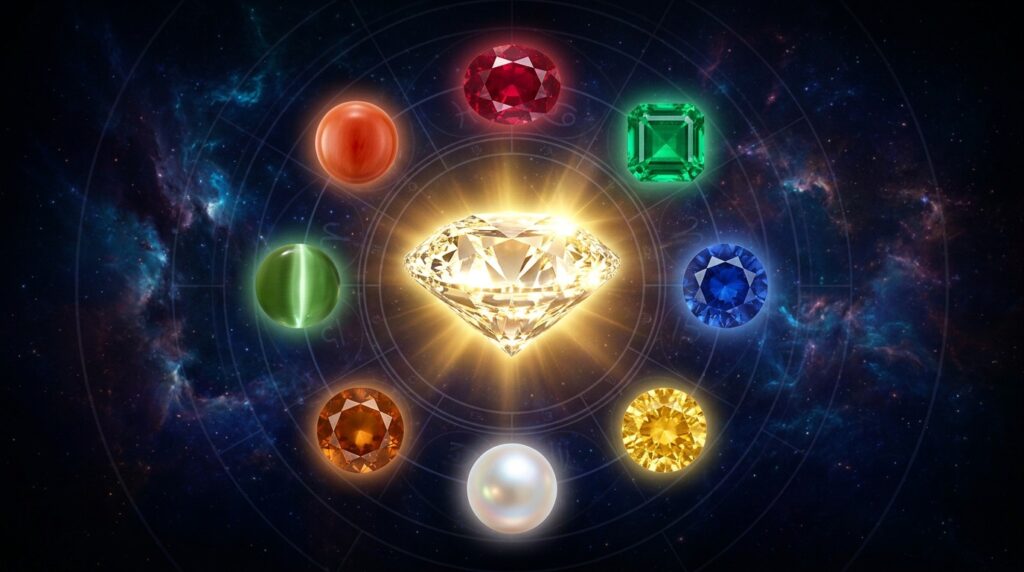
In Vedic astrology, gemstones are classified into Maharatnas (precious stones: Diamond, Pearl, Ruby, Blue Sapphire, and Emerald) and Uparatnas (semi-precious stones: Hessonite, Yellow Sapphire, Cat’s Eye, and Coral). Together these nine stones form the Navaratnas, each linked to one of the nine planets. Maharatnas carry a stronger planetary influence, which is precisely why the method used to prescribe them matters so much.
The Five Methods — And What Each One Gets Right or Wrong
In this approach, the gemstone is determined by identifying the Moon’s position in your horoscope at the time of birth. If the Moon was in Mesha (Aries) when you were born, your Janma Rashi is Aries, and the recommended stone would be Red Coral.
The Moon is genuinely important in Vedic astrology. It governs the mind, emotional patterns, and decision-making. Using it as a reference point for gemstone selection is not unreasonable, and it is one of the most widely used methods.
However, this approach has a significant limitation. It considers only one planet out of nine. If the Moon is placed in the 6th, 8th, or 12th house in your horoscope, or if it governs a difficult house, recommending a gemstone based solely on the Moon sign can actually reinforce a challenging planetary placement rather than support your overall chart.
Janma Rashi tells approximately 25% of the story of your horoscope. Building a gemstone recommendation on that alone is too narrow.
Verdict:
To generic for accurate results
Method 2: Sun Sign (Western Astrology)
The Sun sign is determined by your date and month of birth. Everyone born between July 23rd and August 22nd, for example, falls under Leo, and a Ruby would typically be recommended for all of them.
This is a Western astrology concept, and it is an entirely static one. The same stone is prescribed to every person born in a particular two-month window, regardless of their individual horoscope, their planetary placements, or what is actually happening in their chart.
In Vedic astrology, this level of generalisation has very limited value. It does not account for the Sun’s placement, its strength in the chart, or which houses it governs for that individual. Recommending a gemstone this way is comparable to self-medicating based on a general internet search.
Verdict: Not recommended in Vedic astrology
The Lagna, or Ascendant, is the first house of the horoscope. It represents the body, personal identity, and the overall blueprint of a person’s life. It is one of the most important reference points in Vedic astrology and governs the body’s chemistry, thought patterns, and emotional tendencies.
Using the Lagna as a basis for gemstone selection is more sophisticated than using the Moon sign or Sun sign. It moves us closer to the individual’s actual chart structure.
The limitation, however, is similar to Method 1. The Lagna alone is still too broad. Simply knowing someone’s Ascendant sign does not tell us the strength of the Lagna lord, its placement in the chart, the houses it governs, or how it interacts with other planets. Without this level of analysis, the gemstone recommendation is still not fully personalised.
Verdict: A step in the right direction, but still incomplete
In Vedic astrology, each of the nine planets governs a person’s life for a specific number of years. These periods are called Mahadashas. The Sun governs for 6 years, the Moon for 10 years, Saturn for 19 years, and so on. The sequence and timing of these periods is unique to each individual’s horoscope.
Some astrologers recommend gemstones based on whichever Mahadasha is currently running. If you are in Saturn Mahadasha, they recommend Blue Sapphire. When the period changes to Mercury Mahadasha, they suggest switching to Emerald. And so on throughout your life.
There are two problems with this approach. First, it prescribes a gemstone based on the planet running the Dasha without first analysing where that planet sits in the horoscope, what houses it governs, and whether it is benefic or malefic for that individual. Strengthening a planet that governs difficult houses through a powerful gemstone can cause harm rather than help. Second, this method requires changing gemstones repeatedly over a lifetime, which is neither practical nor, in my view, astrologically sound without a proper chart analysis underpinning each change.
Verdict: Needs full chart analysis to be applied safely
This is the approach I follow in my practice, and in my assessment, it is the only method that can reliably produce an accurate gemstone recommendation.
A full horoscope analysis examines the natal chart in its entirety. It considers the placement of all nine planets, the houses they govern, their strength or weakness, their relationships with other planets, and the Dasha currently operating. It also considers the individual’s specific life situation and what they are seeking support for.
From this complete picture, the gemstones that will genuinely strengthen and support that person’s chart are identified. This may be one stone or a combination of two or three. It is never a generic recommendation based on a sign alone.
Your horoscope is your unique identifier. No two horoscopes are identical, and no two gemstone prescriptions should be either.
Verdict: The right approach — personalised, accurate, and safe
Why Does This Matter So Much?
Gemstones in Vedic astrology are not decorative. They work by amplifying planetary energy. This means that wearing the wrong gemstone does not simply have no effect. It can strengthen a planet that is not beneficial for your chart, activating areas of life that would be better left undisturbed.
I have seen clients who were prescribed Blue Sapphire based solely on their Moon sign or Mahadasha, without any deeper chart analysis. For some of them, Saturn governs challenging houses in their specific horoscope. Wearing a stone that amplifies Saturn’s energy in that context is not helpful.
This is why I always say: a gemstone recommendation is only as good as the horoscope analysis behind it.
What to Expect in a Gemstone Consultation
When you come to me for a gemstone consultation, I read your complete natal chart before making any recommendation. This includes examining which planets are strong and which are weak, which are benefic and which are challenging for your Lagna, what Dasha you are currently running, and what specific areas of life you are seeking support in.
Only after this full analysis do I recommend a gemstone or combination of stones. I also provide guidance on the metal to use, the finger to wear it on, the weight appropriate for your chart, and any rituals or precautions relevant to your situation.
A gemstone worn correctly, based on a proper chart analysis, can provide meaningful support. One worn without that foundation is a risk not worth taking.
If you are currently wearing a gemstone and are unsure whether it is right for you, or if you are considering one, it is always better to base that decision on a complete horoscope analysis rather than a general rule.
Frequently Asked Questions About Gemstones in Vedic Astrology
Can I wear a gemstone based on my Moon sign?
The Moon sign is a commonly used reference point, but it only reflects one planet out of nine in your horoscope. A gemstone recommended solely on this basis may not be suitable for your full chart. It is always safer to have a proper horoscope analysis done before wearing any gemstone.
Is it safe to wear a gemstone without consulting an astrologer?
Gemstones amplify planetary energy. Wearing one without understanding how that planet sits in your specific horoscope carries a real risk. What benefits one person may not benefit another, even if they share the same Moon sign or Sun sign. A proper consultation is strongly recommended before wearing any Maharatna in particular.
Do I need to change my gemstone when my Mahadasha changes?
Not necessarily. If the gemstone was prescribed based on a full horoscope analysis and the planet it supports is genuinely beneficial for your chart, it does not need to change with every Dasha. Changing gemstones frequently based solely on Dasha periods, without proper chart analysis each time, is not recommended.
How do I know which gemstone is right for me?
The only reliable way to determine this is through a detailed analysis of your natal horoscope. The right gemstone depends on your specific planetary placements, the houses those planets govern, their strength in your chart, and your current Dasha. A consultation with a qualified Vedic astrologer is the recommended starting point.